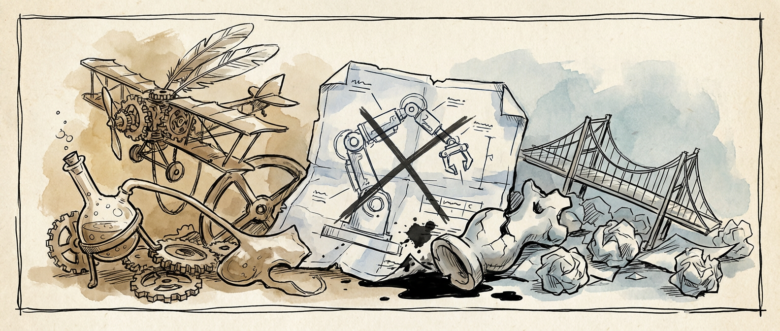
The Geography of Creative Debris
I have a drawer in my desk that I call the graveyard, though that makes it sound more dramatic than it actually is. It’s really just where I keep the remnants of projects that started with enormous enthusiasm and petered out somewhere between the initial spark and anything resembling completion. There’s a half-knitted scarf from 2019 that’s about eighteen inches long and will never be longer. A leather wallet I started tooling that looks like a five-year-old got hold of it. Three different journals with exactly four entries each, all beginning with some variation of “This time I’m really going to stick with it.”
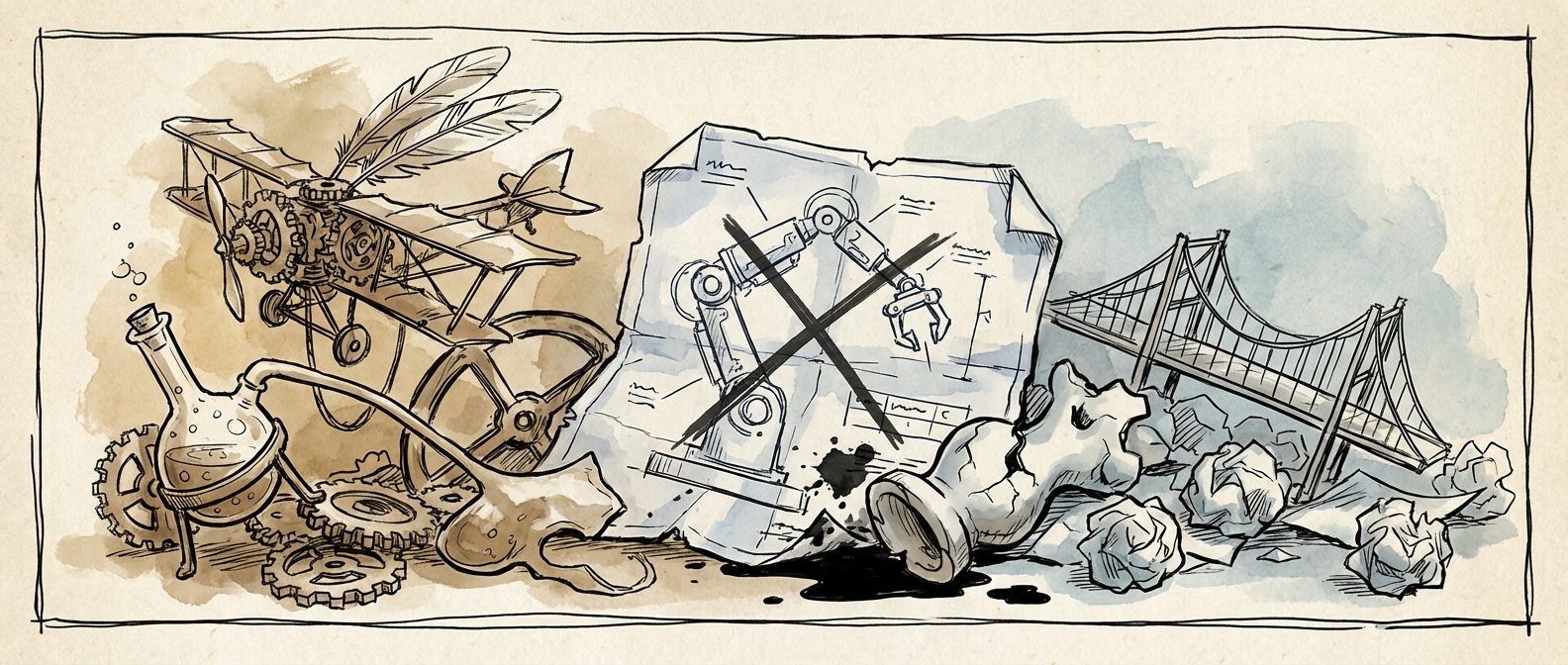
The thing about this drawer is that it’s not really about failure in any meaningful sense. It’s more like an archaeological record of curiosity. Each abandoned project represents a moment when I thought, “What if I could make that?” and then discovered, through direct experience, exactly what it would take to actually make that thing. The gap between imagining and doing, it turns out, is where most of my creative experiments go to die.
But lately I’ve been wondering if that’s the wrong way to think about it entirely. Maybe the drawer isn’t a graveyard at all. Maybe it’s more like a library of small discoveries about what it means to begin something without knowing how it ends.
The Sourdough Incident
Last spring, like approximately half the population during lockdown, I decided to make sourdough bread. I named my starter Harold, which seemed funny at the time but became increasingly awkward as Harold developed what I can only describe as a personality disorder. Some days he would bubble and grow with the enthusiasm of a golden retriever. Other days he would sit in the fridge like a sullen teenager, refusing to respond to fresh flour and water.
The first loaf was a disaster that could have doubled as a doorstop. The second was slightly better but still required a significant amount of optimism to call it bread. By the third attempt, I was reading forums where people discussed their starters like beloved pets, tracking pH levels and hydration percentages with scientific precision. I realized I had accidentally stumbled into a subculture with its own language and deeply held beliefs about fermentation timing.
Harold lived on my counter for six weeks before I admitted defeat and gave him to my neighbor, who already had three starters and welcomed him into what she called her “culture collection.” The last I heard, Harold was thriving under her care and producing excellent focaccia. Some creative experiments, it turns out, are really just elaborate ways of discovering that someone else should be doing the thing you thought you wanted to do.
The Pottery Wheel Revelation
The pottery class was supposed to be relaxing. That’s what the brochure said, anyway. “Find your center,” it promised, next to a photo of someone’s perfectly symmetrical bowl emerging from clay like magic. What the brochure didn’t mention was that finding your center requires first accepting that you don’t have one, and that the clay will cheerfully remind you of this fact every time you sit down at the wheel.
My first bowl looked like it had been formed by geological forces during a particularly violent earthquake. My second attempt collapsed entirely, which was somehow both disappointing and deeply satisfying. There’s something oddly therapeutic about watching your ambitions fold in on themselves in real time. The instructor, a woman named Susan who spoke about clay the way other people talk about old friends, kept saying things like “let the clay tell you what it wants to be.” This struck me as profound until I realized my clay was apparently very committed to being a lumpy mess.
I stuck with the class for the full eight weeks, not because I was getting better exactly, but because I was getting more comfortable with the particular kind of failure that pottery offered. Each session became less about producing something beautiful and more about the strange meditation of working with my hands while my mind wandered. By the end, I could make something that was recognizably bowl-shaped, though I wouldn’t trust it to hold soup.
The real revelation came on the last day when Susan mentioned that she’d been throwing pots for fifteen years and still considered herself a beginner. “The clay keeps teaching,” she said, and I understood that what I’d been calling failure was actually just the early stages of a very long conversation.
The Pattern in the Experiments
Looking back through my creative debris, I’m starting to notice something interesting about the timing of these abandoned projects. They tend to cluster around periods when I’m feeling restless or stuck in other areas of life. The leather working phase coincided with a particularly mind-numbing stretch at work. The knitting happened during a winter when I felt disconnected from everything outdoors. The sourdough experiment began right when I was missing the ritual of cooking for other people.
It’s as if my hands were reaching for something my brain couldn’t quite articulate. Not the finished product exactly, but the process itself. The weight of tools in my hands, the smell of materials, the particular kind of attention that comes from learning to work with your fingers instead of your keyboard. Each failed project was really a successful exploration of what it feels like to be a beginner at something physical and immediate.
The guitar I bought and barely learned to tune is still leaning against the wall in my bedroom, accusingly. But sometimes when I’m walking past it, I’ll pluck a string just to hear the note ring out, and I remember the feeling of pressing my fingertips against the frets for the first time, the sharp surprise of the steel strings, the way my hand cramped as it tried to form an unfamiliar shape. That’s worth something, even if it never became a song.
The Ongoing Experiment
These days I’m trying to befriend the incompleteness rather than fighting it. I’ve started thinking of creative experiments less like projects with defined endpoints and more like conversations that might continue for years or peter out after a single afternoon. Some conversations are meant to be brief and others develop into lifelong friendships, but you can’t always tell which is which at the beginning.
The drawer of half-finished things is still there, still growing. Last month I added a macrame plant hanger that looks like it was made by someone who had never seen macrame but had it described to them by a person who was also unclear on the concept. But I learned something about the particular way rope feels in your hands when you’re trying to convince it to hold a pattern, and about the meditative quality of repetitive knotting, and about how quickly you can go from “this is relaxing” to “why is this rope actively opposing me?”
Maybe the real experiment isn’t whether I finish these projects, but whether I can stay curious enough to keep starting them. The willingness to begin something badly, knowing you might not finish it, knowing you might discover it’s not for you after all. There’s a particular kind of courage in that, though it doesn’t feel courageous at the time. It just feels like reaching for something you can’t quite name.
What’s sitting in your drawer of abandoned experiments? I’m genuinely curious about the creative debris other people accumulate, the trails of half-learned skills and quarter-finished projects that map out the geography of our restless hands. There’s probably a story in each one about what we were really reaching for when we thought we were just trying to make a scarf.