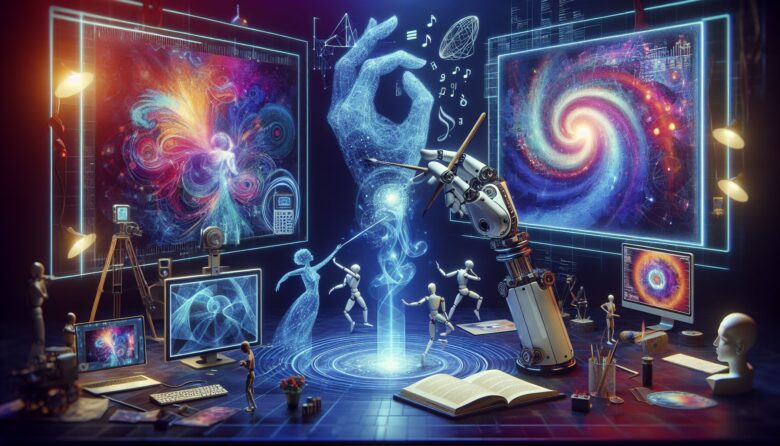
Hey there, fellow tech enthusiasts! I hope you’re sitting comfortably with your beverage of choice, because today we’re diving into the fascinating world of AI in creative arts. I’m sure you’ve heard the buzz—AI has been making quite the splash in everything from corporate boardrooms to scientific labs. But perhaps its most interesting and unexpected ventures have emerged in the realm of art and creativity. Ready to explore? Let’s jump in!
From Code to Canvas
It’s surreal when you think about it—algorithms mimicking human creativity. But that’s exactly what’s happening. Take, for instance, the likes of DeepArt and DALL-E, which can render paintings worthy of spots in any modern art gallery. I remember the first time I saw a piece generated by DeepArt; it transformed an average photo of a cat into a Van Gogh-inspired masterpiece, complete with swirling skies and an uncanny sense of depth and emotion.
So how does it all work? It’s techie wizardry using neural networks—specifically, Generative Adversarial Networks (GANs). You’ve got two neural networks in a playful tango: one generates images, and the other critiques them until they’re indistinguishable from human art. This is the same method artists like Refik Anadol use to create immersive and hauntingly beautiful digital spaces, blurring the line between data visualization and art.
A Muse with Metrics: AI-Poetry and Storytelling
You may be wondering how AI handles poetry—a medium defined by its abstract, emotive verse. Well, prepare to be amazed. With tools such as OpenAI’s GPT models, AI-written poetry has scaled from mere word salad to sophisticated verse. There’s this charming story of an AI poet named Norah A.M., whose works evoke emotion and wonder, making one pause to consider the possibilities of this partnership between silicon and Shakespeare.
I had a blast trying it myself, instructing AI to pen down love sonnets (yes, I was procrastinating on Tinder), and the results were surprisingly warm and coherent. I joke now that if I ever vow to write a heartfelt poem, it might be a collaborative effort with an invisible electronic bard.
Beyond verses, AI is stepping into storytelling. While I’m not yet swapping my favorite sci-fi novels for AI-generated ones, the potential is there. This raises the enchanting (and mildly intimidating) possibility of AI programs crafting narratives that are uniquely tailored to each reader’s taste or mood, taking the ‘choose-your-own-adventure’ game to a whole new level.
Robots Rocking the Stage
Let’s pivot for a moment from static arts to something with a bit more groove—performance arts. Yes, robots are strutting the stage, and it’s as futuristic as it sounds. AI choreographers are crafting pieces that are brought to life by programmable dancers. Projecting emotion through movement, something inherently human, has become a dialogue between creators and machines.
For instance, in Japan, robotic companions are stepping in as actors in elaborate plays. It’s both eerie and exhilarating to watch a mechanical player understand its cues and show what could almost be called personality. While some purists raise eyebrows, I consider it an avant-garde expansion of the artistic canvas.
The Balance of Power: Artists & Their Digital Proteges
As with any powerful tool, AI in the creative arts presents its share of challenges. Discussions around authorship, originality, and the role of traditional artists are more heated than ever. Is art created by AI still art? Does the true artist disappear, or is there a new one born? These questions could make Socrates’ head spin with their complexity. But the human in me hopes this puzzle leads to collaboration over conflict.
We’re already witnessing partnerships that celebrate both the genius of the machine and the spark of the human mind. Creating art, whether through visuals or words, becomes a duet where AI handles some of the laborious bits, allowing the artist to focus on emotion and concept. I once attended a gallery where the exhibition was a combination of human and AI work, indistinguishable but for their attribution. Interacting with each piece was like solving a puzzle, each viewing a new revelation of human and synthetic creative force.
The Road Ahead: Speculative Prose
So, what does the future hold? If popular predictions ring true, intertwining AI with creativity may become ordinary—AI composers scoring movie soundtracks, virtual reality installations dazzling audiences with adaptive art exhibitions, or perhaps AI authors penning your favorite science fiction saga. Imagine a world where every aspect of your daily life is a canvas on which AI can paint, turning the mundane into perpetual wonderment.
While we’re still figuring out where AI’s creative boundaries lie (or if they even exist), one thing’s for certain: we’re standing at a new crossroads. Artists are being enhanced with digital flair, and honestly, I’m excited about this techno-utopia blossoming with endless creative possibilities.
So, whether we’re enjoying an AI’s poignant prose or admiring the brushstrokes of its digital paintings, let’s embrace this colorful blend of art and technology. Until our next exploration, keep dreaming and creating, because if AI has taught us anything, it’s that imagination is limitless.
Stay curious, folks!