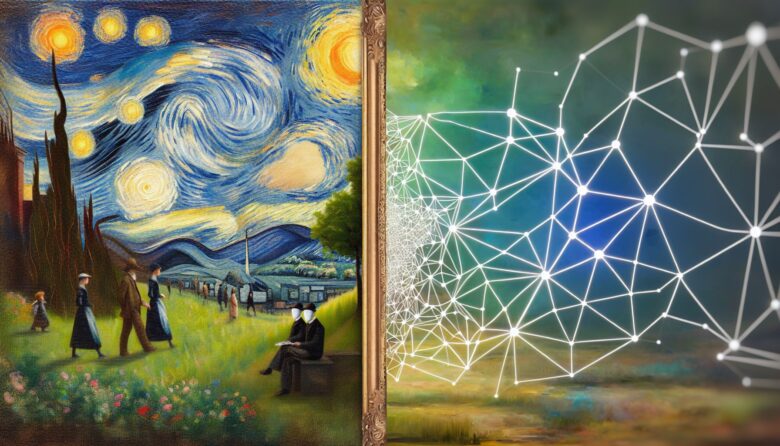
Welcome to the future, my tech-loving compadres! If there’s one thing I never tire of talking about, it’s how technology is making the world look like something out of a sci-fi flick. Today, I want to talk about a particularly juicy area of innovation that’s been making waves and raising eyebrows – Artificial Intelligence in the creative arts.
Dawn of the Creative Bots
Remember watching sci-fi movies where an advanced robot paints like Picasso or composes symphonies like Beethoven? Yeah, we’re pretty much living it. AI is no longer just number-crunching and logical reasoning. It’s breaking into the creative scene, and let me tell you, it’s doing so with flair! Thanks to advances in machine learning and neural networks, we’re seeing AI systems that can compose music, paint masterpieces, and whip up poetry that could bring a tear to Emily Dickinson’s eye.
Testing the Waters: AI and Art Galleries
Not too long ago, I stumbled into a local art gallery, drawn in by the promise of “art created by machines.” There’s something inherently fascinating about mixing the cold logic of machines with the raw emotion of art. Among the paintings, there was one that caught my eye – a canvas of swirling colors and melancholic undertones. It was a creation of an AI program. What struck me was not just its beauty but the complexity of emotions it stirred up.
This brings us to an interesting question: Can AI truly understand and create emotional art, or are we just projecting our feelings onto algorithm-driven patterns? The jury’s still out on that one, but given how these creations are now auctioned alongside human-made art, AI seems to be up for the challenge.
Music to Our Algorithmic Ears
Let’s not skip a beat here – music composed by AI is another fascinating frontier. AI-generated music is becoming more common, from classical to electronic beats. Remember when OpenAI launched MuseNet and everyone went wild over its ability to mimic composers? That was just the beginning. Now, platforms like AIVA and Jukedeck are stepping up the game, providing music companies and independent creators with compositions that are surprisingly human-like.
Here’s a funny thought: someday, you might find yourself at a concert with AI in both the band and the audience. Will we wonder if it enjoys the music just as much as we do? Maybe it’s time for AI to have its own music award category – “Best Non-Human Performance.”
The Written Word: AI Poets and Playwrights
Ah, the power of the pen! Or in our case, the algorithm. AI-generated writing is fascinating territory. OpenAI’s GPT-3 has been making headlines with its ability to craft coherent text that surprises even seasoned writers. We’re learning tips from a machine on how to add flair to our prose. Go figure!
In the realm of poetry, AI’s grasp of metaphors and rhythm can sometimes produce works that feel hauntingly human. There’s a unique charm in knowing that a blend of complex code could reflect the soul of a poet long gone. However, call me old-fashioned, but I still think an algorithm might struggle with the fine line between romantic tragedy and lovelorn puppy doodles.
Potential and Challenges: The Road Ahead
So, where do we go from here? On the one hand, AI in creative arts opens up countless possibilities. Individual creators get a helping hand while industries reimagine the future of content creation. Imagine a world where anyone with a laptop and an internet connection can access these tools to enhance or even redefine what they create.
But, let’s not gloss over the challenges. Copyright, authenticity, and what constitutes creativity are issues that we’re still wrestling with. Who owns AI-generated art? Is it the programmer, the machine, or nobody at all? How do we value this art compared to traditional means? These are questions that demand answers as AI continues to blur the lines between human and machine-made creativity.
Conclusion: Embracing Our Robot Picassos
We’re at the edge of something really interesting. AI in the creative arts isn’t just about copying what humans do. It’s a whole new medium where digital meets the mysterious. Whether it’s catchy tunes, visual wonders, or haunting prose, we’re watching a collaboration between human creativity and machine precision.
As we barrel into this brave new world, one thing is clear: AI isn’t here to replace human artists. Instead, it’s giving us new colors and brushes in the form of bytes and algorithms, allowing us to paint the canvas of the world in ways we had only dreamed of before.
So, let’s embrace our robot Picassos, Bach-bots, and digital Dickinsons while pondering the complexities they bring. And maybe, just maybe, the next masterpiece you cherish will owe its existence as much to silicon as it does to soul. Until next time, keep creating and stay curious!