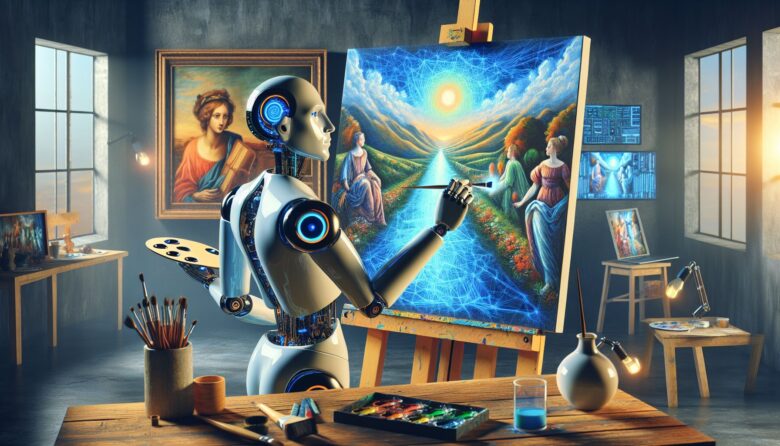
Hey there, fellow tech enthusiasts! Ever feel like we’re living in some epic sci-fi adventure where AI isn’t just a tool, but a partner-in-crime for creativity? I’ve got some exciting stuff to share about the wild ride we’re on with AI in the creative arts. Buckle up, because we’re jumping headfirst into this techno-utopian wonderland.
The State of AI in Creativity
Once upon a time, AI was all about building chatbots or crunching numbers—yawn, right? Fast forward to today, and we’re looking at AI Picasso-wannabes that aren’t just helping artists but becoming artists in their own right. Picture this: paintings, music, and even poetry, all made by clever algorithms that seem to have gulped down gallons of creative juice.
But how did we get here? Well, in recent years, machine learning models like OpenAI’s GPTs and Google’s DeepDream have been pushing the boundaries of what machines can “imagine”. It’s pretty mind-blowing, especially if (like me) you grew up watching sci-fi movies predicting things like flying cars and robot rebellions. Who knew our first co-creators would be digital instead of humanoid?
AI as the New Maestro
Let’s chat about music for a second. Who doesn’t love humming to a catchy tune? Now what if I told you that some of those catchy tunes might soon be composed by AIs? These cleverly programmed bots analyze millions of tracks to understand patterns, melodies, and rhythms. Companies like AIVA and Jukedeck are churning out music that’s surprisingly complex and emotionally engaging.
On a personal note, there’s something hilariously charming about dueling guitars between a human and a machine. My friend Dave—who’s a bit of a music nerd—recently worked with an AI for his new album. He says it was like jamming with an alien who just got into Beatles. At times, the AI completely missed the beat, but other times, it hit a musical home-run out of the galaxy!
Painting Outside the Lines
Now onto visual arts, where AI has been flexing its creative muscles through tools like DeepArt and Artbreeder. By training on thousands of images, these models can generate original artwork from scratch, or even transform existing photos into completely new styles. Remember when everyone wanted those bizarre, dreamlike photos back in the DeepDream debut days? Well, the tech has improved leaps and bounds since.
Visual artists are already using AI to break creative blocks. Imagine you’re an artist staring at a blank canvas (or screen), stuck for inspiration. With a few clicks, you get a fresh take from an AI companion that suggests styles or elements you may never have dreamed on your own. That’s collaboration at its finest, right?
The Unexpected Poets
You might think poetry is a uniquely human endeavor, but AIs like GPT-3 are proving otherwise. Natural language processing tech has advanced to the point where AI-generated poetry can genuinely move you—or at least make you chuckle awkwardly at just how strangely human it sounds. We’re not quite at the level of creating the next Shakespeare, but let’s be real, who is?
I’ve tried dabbling with AI poetry myself—my attempt was like if Dr. Seuss and a digital thesaurus got together for some tea. It was witty, colorful, and completely nonsensical, but I couldn’t help feeling a spark of joy (mixed with a whole lot of confusion). It’s kinder to think of AI poetry as the first draft that sparks fresh new ideas in the human brain.
Challenges: Do Robots Dream of Ethical Guidelines?
Okay, it’s not all rainbows and digital da Vincis. With great power comes great responsibility—a saying that stands just as true in our AI utopia. The rise of AI in the arts raises questions around authorship, intellectual property, and even ethics. If an artwork created by an AI sells for millions, who gets the credit (or profits)?
And let’s not forget about the subtle undercurrent of fear among human artists. Could AI eventually outshine their own creativity? Spoiler alert: I think the answer is no. The unique blend of human experiences, emotions, and spontaneous creativity makes our artistic expressions one-of-a-kind. AI is more of a sophisticated tool than an existential threat.
Peeking Into My Neural Crystal Ball 🌌
What’s next? It’s no stretch to imagine AI will continue evolving into a real muse for humans. We could see more collaborations, perhaps with AI acting as a digital counterpart that amplifies human creativity beyond what’s possible alone. We might get virtual reality galleries for AI-generated work or even interactive performances with cyber-bard improvisations.
Call me an optimist, but I believe as long as we’re willing to embrace these tools and navigate the ethical questions with open eyes, the digital and the analog, the synthetic and the natural, will work together to unlock art forms we can scarcely imagine today. Stay tuned, and who knows what artistic worlds we’ll create together tomorrow.
Thanks for sticking with me to the end of this digital serenade. Whether you’re a coder, an artist, or just a curious wanderer, here’s to the exciting pixelated world of creative exploration! Now go unleash your inner digital Picasso—or just let a friendly AI lend a hand (or algorithm). 🙌