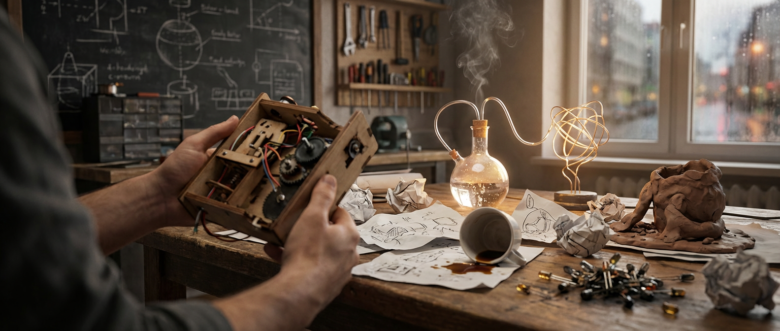
The Archaeology of Good Intentions
I found it while looking for my passport, wedged between old tax documents and a stack of postcards I never sent. My “Process Notebook” from 2019, thick with ambitious project sketches and the kind of earnest handwriting that only emerges when you’re convinced this time will be different. The cover promised organization. The contents delivered something closer to a crime scene of creative ambition.

Page one starts strong with a detailed plan for a stop-motion animation about houseplants having existential crises. There are frame counts, character sketches, even a budget breakdown that assumes I could somehow acquire professional lighting equipment for the cost of a decent sandwich. By page three, the houseplant project has morphed into a podcast about urban gardening failures. Page seven introduces a completely different idea involving hand-lettered protest signs for imaginary causes.
This notebook isn’t unique. Most creative people probably have a graveyard of similar artifacts, each one showing the gap between vision and execution. What surprised me wasn’t the familiar sting of abandoned projects, but how much the process itself had taught me, even when the outcomes were spectacular failures.

The Stop-Motion Disaster Chronicles
Let me tell you about the houseplant animation that never was. The idea seemed foolproof: capture the slow drama of a succulent questioning its life choices while a spider plant offered questionable advice. I spent weeks building a miniature set in my living room, complete with tiny furniture and adjustable lighting rigs made from desk lamps and cardboard.
The first technical hurdle arrived immediately. My phone camera wasn’t adequate for frame-by-frame animation, despite what three different YouTube tutorials promised. Each shot looked like it had been taken during a minor earthquake. I borrowed a proper camera, learned about manual focus, and discovered that taking 24 photos per second of footage requires roughly 1,440 individual shots per minute of animation.
Three days into filming, I had completed roughly four seconds of usable footage and developed what I can only describe as stop-motion induced madness. Moving a plastic succulent one millimeter at a time while hunched over a coffee table triggers some primal human instinct to question all life choices. The project notes from this period become increasingly unhinged. “Why does the plant look angry? Is it the lighting or my soul?” reads one particularly dramatic entry.
The project officially died when my cat discovered the set. One enthusiastic investigation later, my miniature world lay in ruins, and I found myself strangely relieved. But here’s what the notebook captured that I’d forgotten: those weeks of obsessive frame-counting had taught me more about pacing and visual storytelling than months of theoretical study.
The Pivot That Wasn’t
The podcast pivot made sense in that determined way that bad ideas often do. Urban gardening failures felt like natural territory for someone who had just murdered a fictional succulent through stop-motion negligence. I already had stories: the basil that grew into a towering monument to overwatering, the tomato plants that produced exactly one tomato between them, the herb garden that attracted every possible pest except the ones that might have been useful for pest control.
I spent two weeks researching podcast equipment and discovered that decent audio requires more than just talking into your phone with enthusiasm. The notebook from this period reads like a technical manual written by someone slowly losing their grip on reality. There are diagrams of microphone placement, notes about acoustic treatment (blankets hung around your recording space don’t constitute professional sound design, apparently), and a complex chart mapping potential episode topics that suggests I believed I could sustain 50 episodes about plant-related incompetence.
The recording setup eventually consumed most of my bedroom. I had created an elaborate fort of moving blankets, positioned two borrowed microphones according to specifications I didn’t understand, and downloaded editing software that seemed designed specifically to humble anyone who thought podcasting might be simple. My first test recording sounded like I was broadcasting from inside a washing machine during the spin cycle.
What killed this project wasn’t technical difficulties, though. It was the slow realization that I didn’t actually want to be a podcaster. I wanted to be someone who had made a successful podcast. The distinction might seem minor, but it’s the difference between loving the work and loving the idea of having done the work. The notebook entries grow shorter during this phase, eventually trailing off into grocery lists and phone numbers.
The Accidental Education
Reading through these failed experiments now, I’m struck by how much learning happened in the margins. The stop-motion project taught me about visual pacing and the relationship between time and movement in ways that no film class had managed. The podcast attempt forced me to think seriously about narrative structure and the challenge of sustaining interest without visual cues.
More importantly, both failures clarified what I actually enjoyed about creative work. I loved the research phase, the initial problem-solving, the moment when technical challenges revealed unexpected solutions. What I struggled with was the sustained execution, the daily commitment required to transform interesting problems into finished work. This wasn’t a character flaw to overcome but useful information about how I operate.
The notebook also captured something else: the evolution of ideas in real time. The hand-lettered protest signs emerged from frustration with the podcast editing software. While trying to figure out audio waveforms, I started doodling typography, which led to thinking about visual communication, which sparked an interest in sign-making that turned into an actual hobby. Not every thread leads somewhere useful, but some do, and you can’t predict which ones.
The most valuable discovery was how much creative work happens in the space between projects. The notebook shows me moving between ideas not randomly, but following some internal logic that was only visible in retrospect. Each failed project left behind skills, insights, or simply a clearer sense of what I didn’t want to do next.
The Ongoing Experiment
I still keep a process notebook, though I’ve learned to embrace its chaotic nature rather than fighting it. The current one has plans for a zine about neighborhood cats, sketches for a series of postcards featuring local pizza opinions, and detailed notes about whether it’s possible to learn accordion by watching YouTube videos while walking on a treadmill. I have no illusions that all of these will reach completion.
What I’ve come to appreciate is that the notebook itself is the real project. Not the individual experiments it holds, but the ongoing practice of paying attention to what captures my interest and why. It’s become a record of curiosity in motion, a place where ideas can exist without the pressure of immediate success.
The failures documented in these pages aren’t evidence of creative incompetence but of creative appetite. Each abandoned project represents a willingness to start something without knowing how it will end, which might be the most important creative skill of all. Sometimes the best thing you can do for an idea is let it fail spectacularly, take notes on what went wrong, and use those notes to fail better next time.
I’m curious about your own creative graveyard. What projects live in your notebooks or hard drives, half-finished and full of good intentions? Sometimes I think we learn as much from comparing our beautiful failures as we do from celebrating our unlikely successes.

